

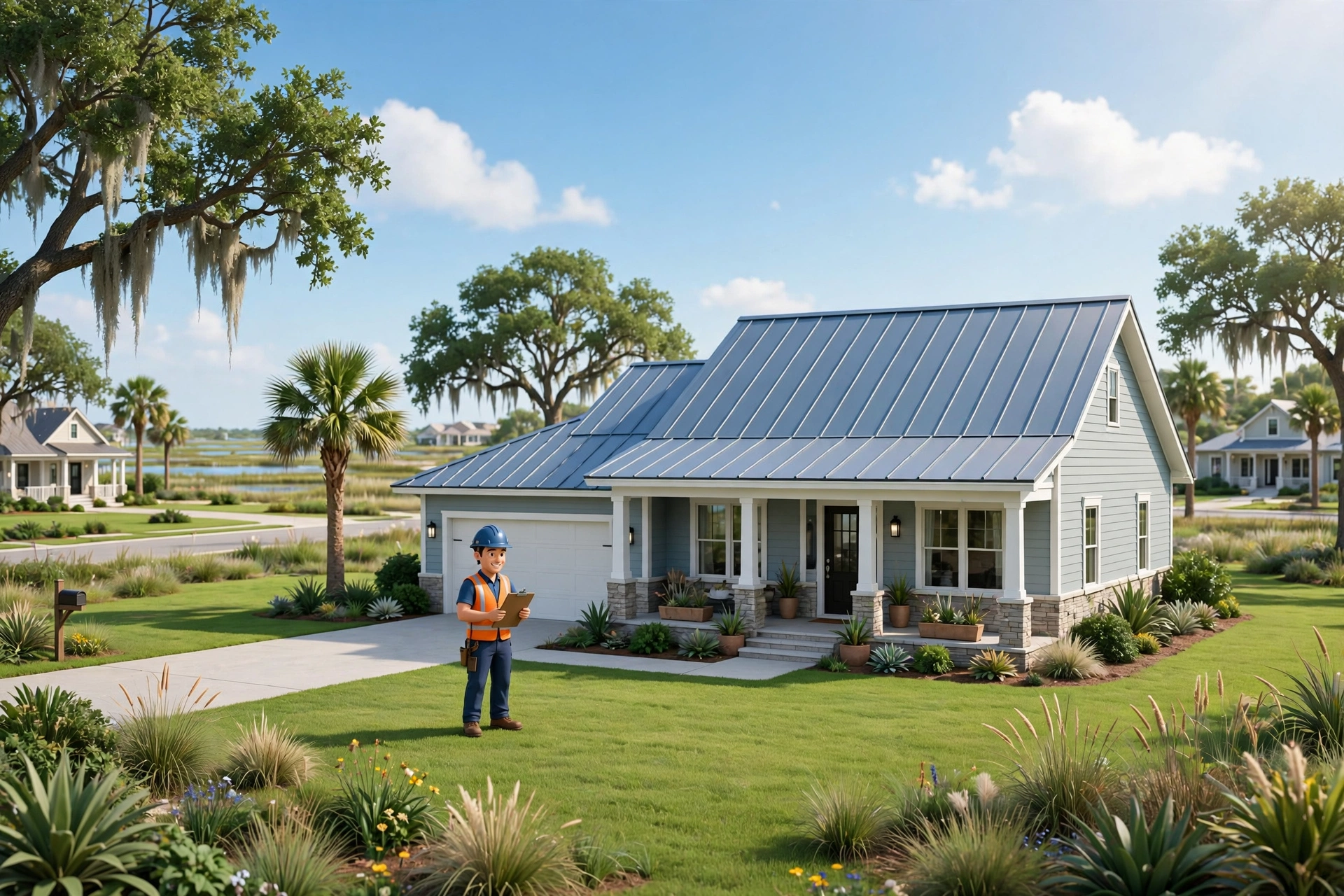
Metal Roof Cost in Texas City, TX (2026)
Metal is the roof Texas City homeowners ask about right after a storm takes their shingles, and the first thing they want is the real number. Here it is: in 2026, an installed metal roof in this area commonly runs $850 to $1,600 per square, materials and labor together. One square is 100 square feet of roof surface.
That is two to three times the price of architectural shingle, and metal still wins a lot of coastal arguments. This guide shows the totals by roof size, explains the two main metal styles, and gives an honest account of where metal earns its price on the Gulf Coast and where it does not.
What a metal roof costs by size
These totals use the $850 to $1,600 per square installed range, standard pitch and a simple shape, before tear off. Roof size means roof surface, not floor plan. If you do not know yours, the Roof Area Calculator gets it from ground measurements.
15 squares (about 1,500 sq ft of roof). Metal runs $12,750 to $24,000 installed.
20 squares (about 2,000 sq ft of roof). Metal runs $17,000 to $32,000 installed.
25 squares (about 2,500 sq ft of roof). Metal runs $21,250 to $40,000 installed.
Tear off of the old roof adds $100 to $175 per square on top. That is roughly $1,500 to $2,625 more on a 15 square roof, $2,000 to $3,500 on a 20 square roof, and $2,500 to $4,375 on a 25 square roof.
Run your own roof through the Roofing Cost Estimator with the metal setting to see where your size lands, then read on for why quotes spread so wide inside the range.
Standing seam vs exposed fastener, in plain terms
Standing seam. Panels lock together with raised seams, and the fasteners hide underneath. No exposed screws to back out or rust through. This is the premium end of the range, commonly $1,100 to $1,600 per square installed on local quotes, and the better pick near salt water. It also sheds wind driven rain well because there is no screw hole line for water to find.
Exposed fastener (screw down). Panels are screwed straight through into the deck, with rubber washers sealing each hole. This is the lower end of the range, commonly $850 to $1,150 per square installed. The trade: those screws and washers age. Over the years, fasteners can loosen and washers can crack in Texas heat, and checking them becomes routine maintenance.
Both styles use the same family of coated steel or aluminum panels. Near the coast, the coating matters more than the style debate. Galvalume and aluminum resist salt air far better than plain galvanized panels. Saving a little on panel coating in Galveston County is expensive later.
Why metal suits the Gulf Coast
Wind. A correctly fastened metal roof has no shingle tabs to lift. Standing seam systems carry high wind uplift ratings, which matters in the windstorm program area. A metal replacement done under inspection can meet the same WPI-8 windstorm standards as any certified roof, and our WPI-8 repair guide explains that certificate.
Salt and sun. Coated metal does not shed granules into the gutters, does not curl in Gulf heat, and shrugs off the salt film that eats lesser materials. Roofs here fail from the environment as much as from age, and metal removes most of that failure list.
Lifespan. Metal is commonly expected to outlast two architectural shingle roofs, often quoted at 40 years or more with basic care. Priced against two shingle replacements plus the repairs between them, the gap narrows fast.
Storm recovery. Metal dents but rarely opens. After a hurricane, shingle roofs leak at thousands of lifted tabs. A metal roof that survives the storm usually needs an inspection, not tarps.
The honest downsides
Upfront price. There is no way around the sticker. Metal asks for two to three times the money on day one, and for a home you may sell in five years, the math gets weaker.
Hail dents. Large hail can dent panels. The dents are usually cosmetic and the roof stays watertight, but a brand new roof can look used after one bad cell.
Noise expectations. The old belief that metal roofs sound like a drum in rain comes from barns with no decking. On a house with solid decking, underlayment, and attic insulation, rain noise lands close to a shingle roof. If your house has a thin roof build, ask the installer what the finished assembly does about sound.
Repairs need the right hands. A future repair has to match panel profile and finish, and finishes fade across decades. Metal rewards good installation and punishes sloppy work, because fewer roofers here specialize in it. When a metal roof does leak, it is usually at a flashing, a fastener line, or a penetration, and our metal roof leak repair guide walks through what those repairs involve.
What is included in an installed metal price
When a metal quote says installed, it should cover more than panels. The package includes the metal panels cut to your roof, a high temperature underlayment rated for metal, ridge and hip caps, valley metal, drip edge, flashing around every chimney, vent, and pipe, and the fasteners or clips that hold it all down. It also includes the labor to strip the old roof if tear off is in the bid, and disposal.
Trim is where metal bids quietly differ. Eave, rake, and valley trim in matching finish costs more than plain galvanized pieces, and it is the first place a cheap bid cuts corners. Ask for the trim and flashing materials to be named in writing, with the same coating as the panels. Mismatched metals in salt air corrode each other and stain the roof.
Ventilation rides along too. A metal replacement is the easiest moment to correct a hot, under-vented attic, and good installers raise it before you sign rather than after the panels are down.
What moves a metal quote up or down
Pitch and shape move it most. Steep slopes and roofs cut up with hips, valleys, and dormers slow the panel work and add trim. Height adds labor. Panel choice adds cost, since standing seam, heavier gauges, and premium coatings all price above basic screw down panels. Tear off adds its own line, and decking repairs found under the old roof get priced per sheet.
Get the same details from every bidder: panel type and gauge, coating, fastener style, underlayment, tear off, decking rate per sheet, and both warranties in writing. The full Texas City roof replacement cost guide shows how to compare those line items across any material.
Get your number, then get it in writing
Measure first. Run your squares through the Roofing Cost Estimator and compare every written quote against that range.
When you are ready for a local written quote on metal, call (409) 290-5353. RoofLeakLocal connects you with an independent Texas City provider. We are a guide and referral site, not a roofing company, and nothing obligates you to hire anyone.
Frequently asked questions
How much does a metal roof cost for a 2,000 sq ft home in Texas City?
Count roof surface, not floor plan. At 20 squares of roof surface, metal runs $17,000 to $32,000 installed in 2026, before tear off. Your pitch, complexity, and panel style place you inside that range.
Is a metal roof worth it on the Gulf Coast?
For a home you plan to keep, usually yes. Wind resistance, salt tolerance, and a lifespan that can cover two shingle roofs make the coastal math kind. For a short holding period, the upfront price is harder to recover at resale.
Should I choose standing seam or exposed fastener here?
Standing seam hides its fasteners, sheds wind driven rain better, and suits salt air, at a higher price. Exposed fastener costs less up front and asks for fastener maintenance over the years. Near the water, standing seam is the safer long term spend.
Will a metal roof lower my insurance bill?
It can help, since wind rated systems sometimes earn wind mitigation credit, and a certified installation supports windstorm coverage. The amount depends on your carrier and your exact roof, so ask your agent with the written specs in hand rather than guessing.
How long does a metal roof last in Texas City?
With the right coating and installation, metal roofs here are commonly expected to last 40 years or more, roughly double an architectural shingle roof. Salt air shortens the life of cheap coatings, which is why Galvalume or aluminum panels are the usual coastal recommendation.
One Comment
Comments are closed.